Friday afternoon. My cutting board and workspace are virtually empty. This goes against nature. The universe laughs with malicious delight. I feel naked and exposed.
What to do? I wrack my brains, despair descends in ever-decreasing circles, blinding me with . . . I have it ! Build a new house for the Golconda project. And maybe share the process with those who like constructing terrain.
Damn altruistic, I be a'thinkin'. And spares me from another manic-depressive spiral.
And clears out some of the crap I've got hanging around the house. Big plus.
First the major components are gathered, so I may commune with them in an atmosphere of mutual appreciation of the journey we will undertake. Life is a journey, time is a river, the world is a village, the door is a jar.
So much for zen.
Anyhoo . . .
The pieces are part of a kit bought by David Veasey from Najewitz Modellbaushop. The link is:
http://www.lasermodellbau.de/
Check out the gallery for some of the buildings I have made using these kits.
Resin walls, laser-cut roof and roof supports. Gives quite a scope to the variety of buildings that can be created. And don't forget, all sins can be covered with superglue, Squadron Green Stuff, paint and flocking material.
Nice texture on the walls, open windows with great middle eastern shapes. The resin can be cut, though not easily, but perseverance pays off. The following pics show a building I made, where I cut side walls in half to create an upper storey with balcony. None too shabby.
And back to the job at hand. Laser cut wooden pieces for roof support. More anon.
Clean up of resin ensues. Excess resin is removed from windows and doors and from the little holes above the windows. The tabs are removed from the top of the wall. These are locaters if an upper storey is to be built. As this is a single storey, off they come.
The wooden supports are placed and glued into these little holes.
You might have noticed the domes in a previous pic. These are two halves of a water tower from a model railroad kit, specifically Faller N222143. Using the dome pieces leaves a variety of girders and ladders, sure to be useful in future projects. No part of the animal is wasted after the kill.
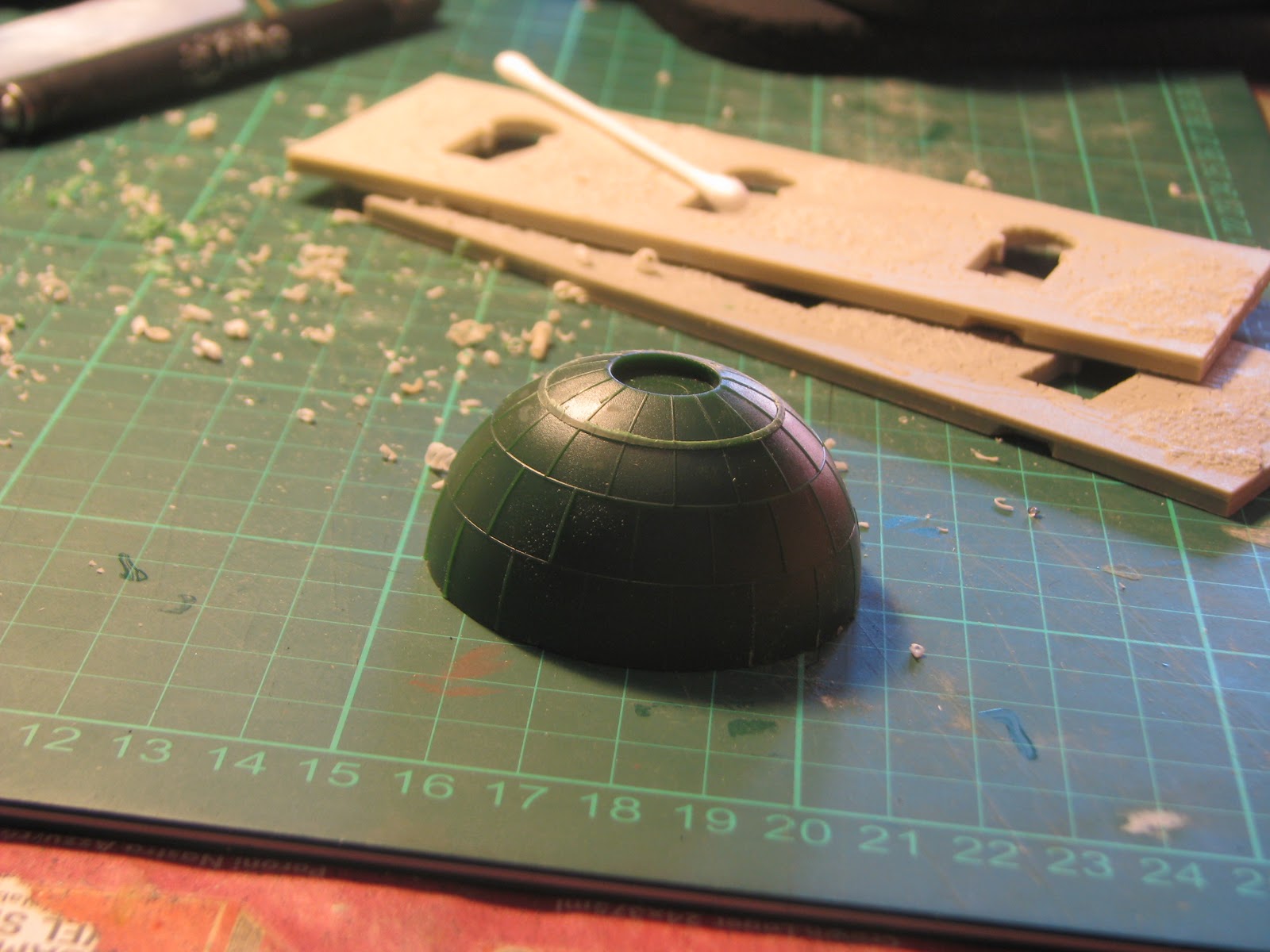
The dome is sanded back to remove the weld lines leaving a smooth surface and is glued to the roof section. Two open trapdoors in the roof are also closed as are the doors in one of the wall sections.
Now the fun bit. I found this product in my local art store. Sticky backed grillwork. Well, that's what I use it for. Just peel it off the backing paper and apply.
By placing it over the windows, sticky side to the wall, it creates a great grill effect for middle eastern and Indian buildings.
Don't worry about the sticky side facing out of the windows, paint will cover it thus negating the sticky effects. (Only here will the word "thus" be used - I promise).
I am left with the backing paper, but here's a thought:
Mosaic flooring! Hey, nothing of the animal is wasted . . . yeh, yeh, said that already.
The sticky stencilling is about $3 a sheet at my art store (Eckersleys for those in Oz) and comes in a variety of designs.
For example the leaf design on the dome and the curlicues below the arches are from this range. If I can remember the name of the manufacturer I will post it. But in the interim I would suggest checking out the scrap-booking section of your local arts and crafts shop.
The pieces were all put together (juggled together), not easy but eventually they bonded.
The interior was sprayed black.
The building was then glued to a piece of card to stabilise the walls and provide a landscaping space, and the roof and dome were covered with Tamiya Diorama Texture Paint (Grit Effect). This stuff is great, water-soluble and gives a good earthy effect to scale.
The next step will be filling, painting and landscaping, so stay tuned.
Ain't it grand? It's all too damned wonderful, to be sure.
Cheers
PC
Whilst so ever there is one unpainted figure upon my shelf, I shall never die.
Friday, March 4, 2011
Saturday, February 26, 2011
Mighty Mumaks
Gotta love the Mumaks. This is a piece I worked on about three years ago. Originally in the Veasey collection, it now resides in the swiftly expanding Blaxland-Walker collection, along with many other LOTR pieces. Many, many pieces.
I love this beastie, and it was great to get my hands on it again. I spent many hours with a pin-vised drill bit, superglue and a pile of satay sticks, but I think I got the look I was after.
The model as it comes from the box was intriguing but just didn't quite have the savagery I remembered from the movie. It needed sharp pointy bits and many of them. Basically I decided that wherever there was a bamboo pole terminating on the howdah, it was going to be extended and occasionally bulked out.
It was just a matter of drilling the holes to accept the satay sticks, and using superglue to hold them. Most of the satay bundles were simple, consisting of three sticks, two short, one longer, tied together roughly with a thick rigging thread used in rigging wooden model ships. Some were a little more substantial, but the method was much the same. Cut sticks, drill holes, insert sticks, wrap sticks with cord, holding sticks together and covering join between sticks and plastic.
The tusks were another story, but just as simple. I took lengths of cord and tied smaller satay sticks sharpened at both ends along the length of the cord at equal intervals, about 2 cms between each stick. I then wrapped the length of cord around the tusk. The cord length was about 20 cms.
I experimented with hanging banners from the howdah but it all looked too busy. Especially with the suitably savage-looking designs painted on the mumak's hide. Saved time and trouble. And with the crew installed the beastie was more than ready to instil fear in the hearts of the Gondormen.
The following are samples of the crew painted for the mumak. I chose a colour scheme different from the advertised GW and movie theme, as I wanted to represent one of the other wild desert tribes. A soft tan brown with blue accents and turquoise stone decorations seemed to fit the bill.
Over the next little while there will be more pics of various units from this collection.
Here is a little taste.
I was going to do a little editorial about LOTR the movie, but I can't be bothered. We all have our opinions and they are never going to match up absolutely. I loved Lord of the Rings, loved Star Trek (the new one), I hated Harry Potter (all of them and the books, elitist, class-based fantasy rip-off of the Famous Five, Jim Butcher's Harry Dresden Chronicles kicks Potter in the head . . . sorry, ranting), I thought Avatar was beautiful to look at but sucked as a story (come on, let's be honest, unobtanium, what the hell, was it trying to be a Flash Gordon serial in the 1930's? . . . all the millions Cameron spent on his 3D experiment, would it have killed him to fork out $10 for a legal pad and a pencil and write a decent script . . . and don't get me started on Sam Worthington, what a black hole of talent . . . sorry again, sorry, another rant).
You see, I get emotional about these things. So occasionally I will drop in a little snippet of my opinions, but I will try to keep them in check.
That's the kind of guy I am.
So while I sip my last martini for the evening, I'll say goodnight and goodbye 'til next we meet. When you're this way again, join us here at the Starlight Ballroom and Grill where the girls are free but the drinks are not. Don't forget to tip your waitress and next time . . . try the veal.
Signing off
Peter C.
I love this beastie, and it was great to get my hands on it again. I spent many hours with a pin-vised drill bit, superglue and a pile of satay sticks, but I think I got the look I was after.
The model as it comes from the box was intriguing but just didn't quite have the savagery I remembered from the movie. It needed sharp pointy bits and many of them. Basically I decided that wherever there was a bamboo pole terminating on the howdah, it was going to be extended and occasionally bulked out.
It was just a matter of drilling the holes to accept the satay sticks, and using superglue to hold them. Most of the satay bundles were simple, consisting of three sticks, two short, one longer, tied together roughly with a thick rigging thread used in rigging wooden model ships. Some were a little more substantial, but the method was much the same. Cut sticks, drill holes, insert sticks, wrap sticks with cord, holding sticks together and covering join between sticks and plastic.
The tusks were another story, but just as simple. I took lengths of cord and tied smaller satay sticks sharpened at both ends along the length of the cord at equal intervals, about 2 cms between each stick. I then wrapped the length of cord around the tusk. The cord length was about 20 cms.
I experimented with hanging banners from the howdah but it all looked too busy. Especially with the suitably savage-looking designs painted on the mumak's hide. Saved time and trouble. And with the crew installed the beastie was more than ready to instil fear in the hearts of the Gondormen.
The following are samples of the crew painted for the mumak. I chose a colour scheme different from the advertised GW and movie theme, as I wanted to represent one of the other wild desert tribes. A soft tan brown with blue accents and turquoise stone decorations seemed to fit the bill.
Over the next little while there will be more pics of various units from this collection.
Here is a little taste.
I was going to do a little editorial about LOTR the movie, but I can't be bothered. We all have our opinions and they are never going to match up absolutely. I loved Lord of the Rings, loved Star Trek (the new one), I hated Harry Potter (all of them and the books, elitist, class-based fantasy rip-off of the Famous Five, Jim Butcher's Harry Dresden Chronicles kicks Potter in the head . . . sorry, ranting), I thought Avatar was beautiful to look at but sucked as a story (come on, let's be honest, unobtanium, what the hell, was it trying to be a Flash Gordon serial in the 1930's? . . . all the millions Cameron spent on his 3D experiment, would it have killed him to fork out $10 for a legal pad and a pencil and write a decent script . . . and don't get me started on Sam Worthington, what a black hole of talent . . . sorry again, sorry, another rant).
You see, I get emotional about these things. So occasionally I will drop in a little snippet of my opinions, but I will try to keep them in check.
That's the kind of guy I am.
So while I sip my last martini for the evening, I'll say goodnight and goodbye 'til next we meet. When you're this way again, join us here at the Starlight Ballroom and Grill where the girls are free but the drinks are not. Don't forget to tip your waitress and next time . . . try the veal.
Signing off
Peter C.
Saturday, February 12, 2011
Sumerian DBA in 28mm
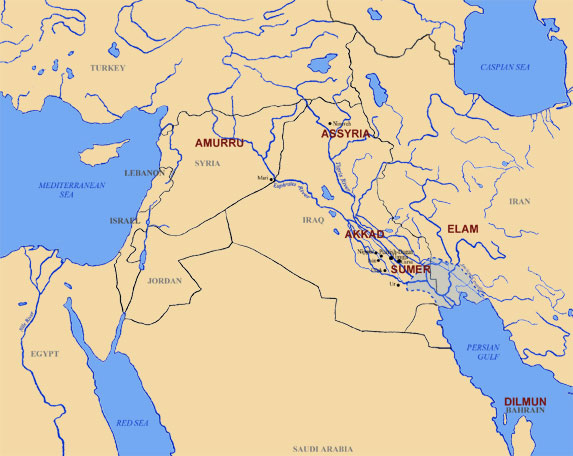
I am fascinated by the rise of cultures and their collapse. Lessons can be learned, as they can with all history, but none more so than in the ways in which humans find a civilising place in their environment, and the many ways in which they can screw it up.
The later Roman Empire always held this fascination, less for any sudden collapse, but more for the way in which it slowly meandered off to the side, to be replaced by yet another group of humans looking for their place in the world.
The Sumerian city-states didn't seem to have the time to meander anywhere. Their collapses and defeats were quick and decisive, and seemed to follow the Dynastic Rule of Three: the first lugal (lugal = big man, king) established a city (like Ur or Lagash) and its control over the surrounding area, the next lugal (usually a son) held and expanded the territory (at the expense of other cities), and finally a last lugal (again a descendant of the first man) lost the lot.
This continual rise and fall was the product of an agrarian civilisation: agriculture led to surplus, which led to taxes to establish urban growth and organisation, which required a defensive system to protect this way of life from other aggressive city-states, under the control of the lugal, the priest-king, men with names like Gilgamesh, Lugalbanda the shepherd, Dumuzi the fisherman, and Lugalkidul.
This protection was made up of close-formation infantry, skirmishers and battle wagons. It was a system that would last for nearly four thousand years.
The best quick read for the history of the period is Susan Wise Bauer's History of the Ancient World, a no-nonsense coverage of the known information based on up-to-date research and historiography, with the bonus of not having to wade through tons of historical speculation. It simply tells it as it appears to be. It also covers available histories concerning areas usually avoided by western scholars, like China and the East. By no means exhaustive or particularly deep, but the sort of history I wish I had in high school to set things into perspective.
Back to the Sumerians.
Infantry made up the bulk of the armed forces taking part in this never-ending round of rises and falls. Long leather, bronze or copper studded cloaks, sheepskin or leather kilts and bronze or copper helmets were worn by the massed spears of these armies. The troops were armed with a long spear that appeared to be carried in two hands, indicating some length.
These spears probably marched in formation, using bulk and weight of massed bodies to force an enemy to break, with the long spears adding killing power from the ranks. Later addition of shields may have shortened the spear to one-handed length, or a shield bearer may have been employed.
Other troops included loose formation infantry, either axe or spear armed, with apparently no armour.
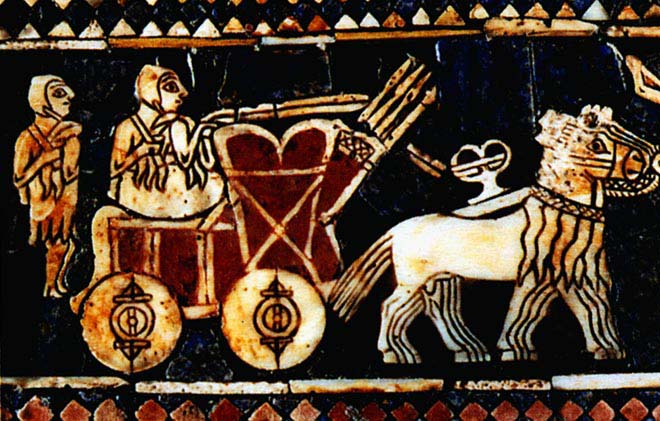
And a special troop formation was the four onager battle cart, a cumbersome, probably bone-rattling four-wheeled platform, possibly used less as a killing machine than as a means of transport to the battlefield, or a high point for observing the fight. Even with four onagers dragging it across the rocky Sumerian landscape, it would have been relatively slow compared to later cavalry or chariotry, and the turning circle would have been a nightmare.
The Sumerian military system finally collapsed when it was confronted by stronger and more innovative attackers. The Akkadians, under Sargon I, and subsequent kings would eventually bring the Sumerian kingdoms under their control, only to lose them again with the rise of Third Dynasty of Ur, the kings of which used Akkadian mercenaries to bolster their forces. Sumer, however, would lose to the Babylonians, and would never again return to its former power.
Other feet now tread upon the remains of Uruk, Lagash, Kish and Ur.
I met a traveller from an antique land
Who said: "Two vast and trunkless legs of stone
Stand in the desert. Near them on the sand,
Half sunk, a shattered visage lies, whose frown
And wrinkled lip and sneer of cold command
Tell that its sculptor well those passions read
Which yet survive, stamped on these lifeless things,
The hand that mocked them and the heart that fed.
And on the pedestal these words appear:
`My name is Ozymandias, King of Kings:
Look on my works, ye mighty, and despair!'
Nothing beside remains. Round the decay
Of that colossal wreck, boundless and bare,
The lone and level sands stretch far away".
- Percy Bysshe Shelley
A cautionary tale.
Hope you enjoyed
PC
The later Roman Empire always held this fascination, less for any sudden collapse, but more for the way in which it slowly meandered off to the side, to be replaced by yet another group of humans looking for their place in the world.
![]() |
| Mesopotamia |
This continual rise and fall was the product of an agrarian civilisation: agriculture led to surplus, which led to taxes to establish urban growth and organisation, which required a defensive system to protect this way of life from other aggressive city-states, under the control of the lugal, the priest-king, men with names like Gilgamesh, Lugalbanda the shepherd, Dumuzi the fisherman, and Lugalkidul.
This protection was made up of close-formation infantry, skirmishers and battle wagons. It was a system that would last for nearly four thousand years.
![]() |
| Unknown lugal from the Ur stelae |
![]() |
| Artist's representation of Ur |
![]() |
| Lagash - a romanticised view |
Back to the Sumerians.
![]() |
| Spearmen - Ur stelae |
These spears probably marched in formation, using bulk and weight of massed bodies to force an enemy to break, with the long spears adding killing power from the ranks. Later addition of shields may have shortened the spear to one-handed length, or a shield bearer may have been employed.
![]() |
| Later shielded spearmen |
And a special troop formation was the four onager battle cart, a cumbersome, probably bone-rattling four-wheeled platform, possibly used less as a killing machine than as a means of transport to the battlefield, or a high point for observing the fight. Even with four onagers dragging it across the rocky Sumerian landscape, it would have been relatively slow compared to later cavalry or chariotry, and the turning circle would have been a nightmare.
![]() |
| Sumerian lugal's helmet |
Battle cart - Ur stelae
![]() |
| Assembled forces of Sumerian lugal - by the great Angus McBride |
The Sumerian military system finally collapsed when it was confronted by stronger and more innovative attackers. The Akkadians, under Sargon I, and subsequent kings would eventually bring the Sumerian kingdoms under their control, only to lose them again with the rise of Third Dynasty of Ur, the kings of which used Akkadian mercenaries to bolster their forces. Sumer, however, would lose to the Babylonians, and would never again return to its former power.
![]() |
| 17th Fires Brigade, US Army, ziggurat of Ur, May 18th 2010 |
I met a traveller from an antique land
Who said: "Two vast and trunkless legs of stone
Stand in the desert. Near them on the sand,
Half sunk, a shattered visage lies, whose frown
And wrinkled lip and sneer of cold command
Tell that its sculptor well those passions read
Which yet survive, stamped on these lifeless things,
The hand that mocked them and the heart that fed.
And on the pedestal these words appear:
`My name is Ozymandias, King of Kings:
Look on my works, ye mighty, and despair!'
Nothing beside remains. Round the decay
Of that colossal wreck, boundless and bare,
The lone and level sands stretch far away".
- Percy Bysshe Shelley
A cautionary tale.
Hope you enjoyed
PC
Subscribe to:
Posts (Atom)